Most gemstones are chosen for a colour that remains broadly consistent. Alexandrite offers something altogether more intriguing. Its appearance can shift noticeably as the light changes, giving an engagement ring a different character in daylight, indoor illumination and evening settings. Rather than being defined by one fixed hue, the gemstone is appreciated for the relationship between those colours.
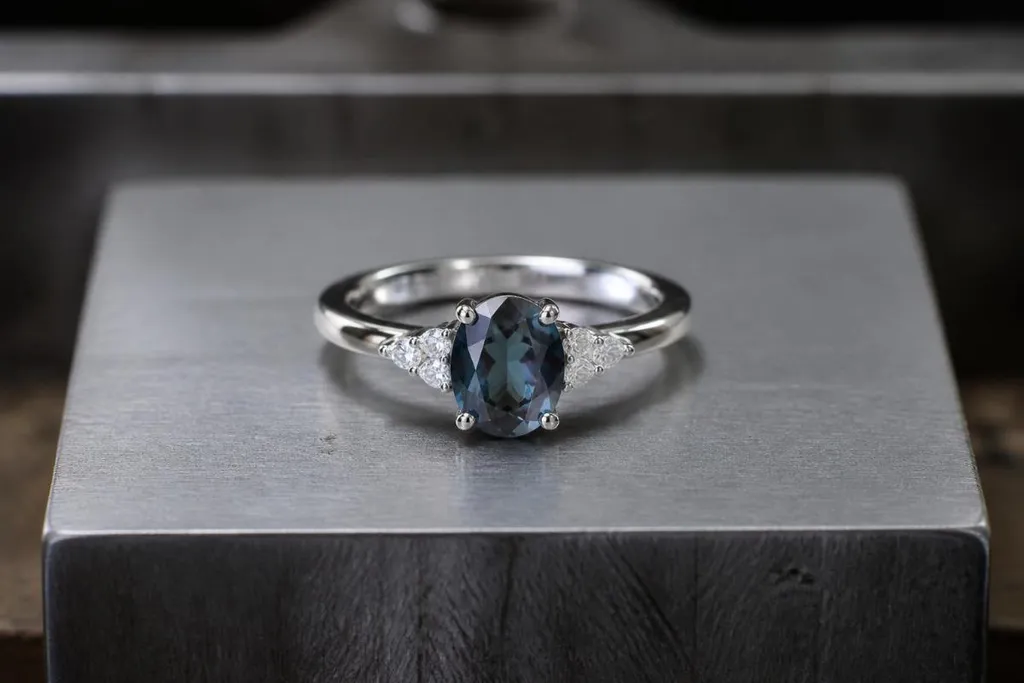
For couples seeking something less conventional, timeless lab grown alexandrite engagement rings bring this unusual optical quality into contemporary fine jewellery. Lab-grown alexandrite can display the distinctive colour-change phenomenon associated with the gemstone while allowing the cut, setting and metal to shape how that transformation is perceived. Choosing well means assessing more than a single photograph or colour description.
What Causes Alexandrite to Change Colour?
Alexandrite is a variety of chrysoberyl. Its celebrated colour change results from the way the material absorbs and transmits different wavelengths of light, influenced by trace elements within its crystal structure.
As the balance of wavelengths changes between light sources, so does the colour perceived by the eye. An alexandrite may show greener, blue-green or related tones under daylight-type illumination before shifting towards red, purple or purplish hues under warmer incandescent light.
The precise colours and strength of the transition vary between stones. This means the most important question is not simply, “What colour is it?” but rather, “How does it behave across different lighting?”
For an engagement ring that will be worn from daytime meetings to evening dinners, that variability becomes part of its personality rather than a characteristic to eliminate.
Look at Colour Change Before Carat Weight
With alexandrite, size should not automatically take priority over the quality of the visual effect. A larger gemstone with a less compelling colour transition may be less appealing to a particular wearer than a smaller stone whose change is more distinctive.
This provides a useful way to think about 1-carat versus 2-carat options. Someone might favour a 2-carat lab-grown alexandrite because the increased surface area makes its shifting colour a stronger visual feature on the hand. Another person may deliberately select a smaller stone because its colour behaviour is more attractive or because it creates better proportions with a delicate band.
Actual dimensions also matter. Different cuts distribute weight differently, so two stones of comparable carat weight may not have identical face-up presence.
Alexandrite is therefore best judged as a complete visual experience: colour, transition, cut and proportion together.
Choose a Cut and Setting That Showcase the Stone
Cut influences how light travels through alexandrite and therefore plays an important role in how lively and expressive the gemstone appears.
Oval cuts offer elegant length and a softer silhouette, while cushion shapes provide fuller proportions with gently rounded corners. Round cuts create familiar symmetry and can make an unusual gemstone feel more traditionally bridal. More geometric shapes can give alexandrite a sharper, contemporary character.
A solitaire keeps attention entirely on the colour-changing centre stone. For someone who wants greater contrast, a halo of colourless diamonds can create a bright frame without introducing another competing colour. Diamond-set shoulders offer a subtler way to add brilliance along the band.
Setting height should also reflect everyday habits. A dramatically raised setting can give the gemstone greater prominence, while a lower profile may suit someone who regularly works with their hands.
Metal Choice Changes the Colour Conversation
Because alexandrite changes according to its environment, metal selection becomes especially interesting.
Platinum and white gold create a cool, relatively neutral frame that can complement the gemstone's greener or cooler expressions. Yellow gold adds warmth and may create a richer contrast as the stone moves towards red or purple tones.
Rose gold offers another interpretation, particularly for someone drawn to alexandrite's warmer phases. Rather than providing strong contrast, it can create a softer tonal relationship between gemstone and band.
Practicality remains important. Alexandrite has a Mohs hardness of approximately 8.5, making it well suited to frequent jewellery wear, although it should still be protected from unnecessary impacts. Gentle cleaning and periodic professional checks of the setting are sensible for any engagement ring worn regularly.
Final Thought
Alexandrite engagement rings are compelling because they resist having a single fixed appearance. The gemstone responds to changing light, revealing different colours as the wearer moves through the day.
That makes a lab-grown alexandrite especially suited to someone who values subtle complexity over conventional uniformity. Choose for the quality of the colour change, thoughtful proportions and a setting that lets the gemstone remain the focus, and the result is an engagement ring whose character continues to reveal itself long after it is first worn.